
The Competitive Adsorption
Pesticide formulation synergism can generally be achieved either through in-formulation incorporation or by tank-mixing the synergist at the time of application. Compared with tank-mix approaches, incorporating a synergist directly into an SC presents a greater challenge because it must remain compatible with the formulation throughout processing and storage. An SC typically contains a high loading of active ingredients, leaving only limited flexibility for additional additives, with synergists generally used at levels of 3–10%. At an insufficient dosage, the synergistic effect may be too weak to provide a meaningful benefit. Increasing the dosage, however, can compromise physical stability, leading to higher viscosity, paste formation, phase separation, sedimentation, and poor redispersibility after accelerated storage. The challenge, therefore, is to achieve a meaningful synergistic effect at a relatively low addition level without compromising the long-term stability of the SC.
Most synergists have low surface tension and high interfacial activity, allowing them to reduce interfacial energy and improve the wetting, spreading, and penetration of the spray solution. The same interfacial activity, however, can interfere with the dispersion system by competing with dispersants for adsorption sites on the surfaces of active ingredient particles. If the dispersant is not strongly adsorbed enough, the synergist may partially displace it from the particle surface. This can promote particle re-agglomeration and lead to a series of formulation problems. For this reason, successful in-formulation synergism is not simply a matter of increasing the synergist level. A more fundamental approach is to improve the dispersant's resistance to competitive adsorption, allowing it to remain firmly anchored to the active ingredient surface even in the presence of a highly surface-active synergist.

Fig. 1. Competitive Adsorption on the Particle Surface
SP-DIS04N Design
To address this issue, SINVOCHEM has developed SP-DIS04N, a polycarboxylate dispersant designed to provide strong and durable adsorption on active ingredient particles. Its relatively long carbon backbone and multiple active adsorption sites, combined with strongly polar groups arranged along the polymer chain, give the molecule a comb-like architecture. This enables SP-DIS04N to establish a dense, multi-point adsorption layer on particle surfaces. Compared with the relatively loose adsorption layers formed by conventional polycarboxylate dispersants, which are more susceptible to displacement, SP-DIS04N provides stronger anchoring and greater steric stabilization. As a result, it minimizes disruption of the dispersant layer by synergists while helping to suppress particle aggregation, particle growth, and sedimentation. In practical terms, this allows the two components to perform complementary roles: the synergist delivers the desired interfacial performance, while SP-DIS04N protects the dispersion system and maintains formulation stability.

Fig. 2. Mechanism of Competitive Adsorption Resistance of SP-DIS04N
Applied Case: 15% Chlorantraniliprole + 10% Chlorfenapyr SC
3.1 Formulation Performance
Table 1. Formula of 15% Chlorantraniliprole + 10% Chlorfenapyr SC
|
Components |
Description |
Content (% w/w) |
|
Chlorantraniliprole |
AI |
15 |
|
Chlorfenapyr |
AI |
10 |
|
SP-SC99 |
Wetting dispersant from SINVOCHEM |
2 |
|
SP-DIS04N |
Dispersant from SINVOCHEM |
2.5 |
|
Synergist |
SP-TM05/SP-TM02/SP-TM10/SP-AC40 (polyether based) |
3–10 |
|
Others |
/ |
q.s. to 100% |
Table 2. Formulation Stability Comparison Using Dispersants and Synergists from Different Sources
|
Dispersant |
Synergist |
Particle size (Initial; D90/μm) |
Stability (After 1 year) |
D90 (After 1 year, μm) |
|
SP-DIS04N |
10% SP-TM02 |
2.979 |
No water separation |
4.325 |
|
SP-DIS04N |
3% SP-TM05 + 3% SP-AC40 |
3.046 |
Slight water separation |
4.538 |
|
Commercial dispersant |
5% SP-TM02 |
2.965 |
55% water separation |
10.35 |
In the 15% chlorantraniliprole + 10% chlorfenapyr SC formulation, the initial particle size (D90) of the commercial dispersant system was comparable to that of the SP-DIS04N system. After long-term storage, however, the particle size of the commercial dispersant system increased from 2.965 μm to 10.35 μm, accompanied by 55% phase separation and significant sedimentation. By contrast, SP-DIS04N showed much better compatibility than the commercial benchmark with different synergist systems. After one year of storage, the sample remained uniform, showing no significant sedimentation. (Fig. 3)

Fig. 3. Visual comparison between the commercial formulation and SP-DIS04N system
Multiple Light Scattering (MLS) analysis using a Turbiscan® instrument was used to rapidly assess the storage stability of the formulations containing synergists, and the conclusions from the MLS profiles were consistent with the results observed during actual long-term storage (Fig. 4).

Fig. 4. Comparison of MLS profiles between the commercial formulation (left) and SP-DIS04N system (right)
These results indicate that SP-DIS04N can maintain a stable dispersion system even when synergists with strong interfacial activity are present, effectively limiting particle growth and reducing the risks of phase separation and water separation (syneresis) over extended storage.
3.2 Optimization of Interfacial Properties after Adding Synergists
Table 3. Comparison of Interfacial Properties
|
No. |
Dispersant |
Synergist |
Dilution ratio |
Contact angle/° |
Wetting time |
Spreading area/mm² |
Static surface tension/mN/m |
|
1 |
SP-DIS04N |
/ |
1000 |
92.53 |
No wetting |
20 |
46.96 |
|
2 |
SP-DIS04N |
3% SP-TM05 + 3% SP-AC40 (1:1 blend) |
1000 |
61.02 |
12 min 54 s |
38 |
29.86 |
|
3 |
SP-DIS04N |
10% SP-TM02 |
1000 |
58.84 |
34 min |
38.84 |
31 |
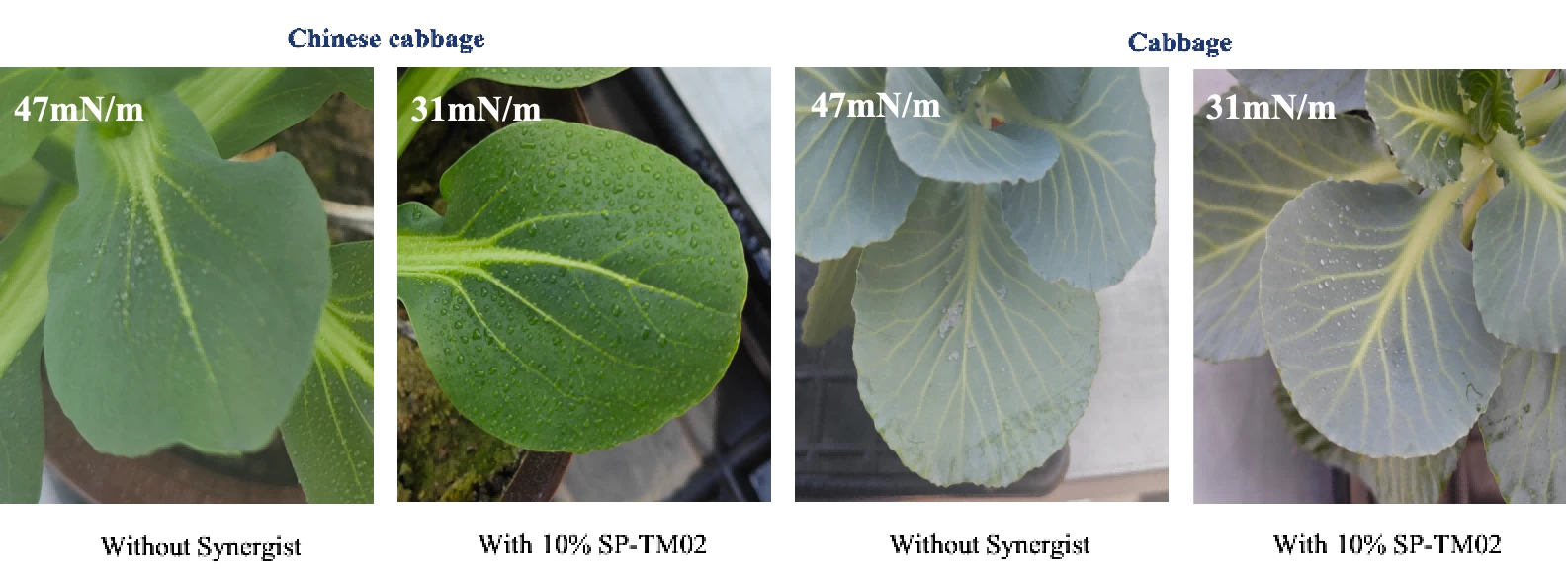
Figure 5. Leaf spray test: Surface tension measurement of spray dilution solutions
At the same dilution ratio, incorporating the synergists reduced the surface tension of the formulation from 46.96 mN/m to approximately 30 mN/m. The contact angle and wetting time were also significantly reduced, while the spreading area increased from 20 mm² to approximately 38 mm². These results show that SP-DIS04N can preserve the physical stability of the SC without suppressing the interfacial performance of the synergist.
3.3 Other Applications of SP-DIS04N
SP-DIS04N has also been evaluated in a range of high-loading, synergist-containing SC formulations that are inherently difficult to stabilize, as shown in Table 4.
Table 4. Compatibility of SP-DIS04N with Various High-Loading and Challenging SC Formulations Incorporating Synergists
|
Formulation |
Dispersant |
Synergist |
Particle size (Initial; D90/μm) |
Particle size (54 ℃ 14 d; D90/μm) |
Water separation (54 ℃ 14 d; %) |
|
20% Chlorantraniliprole SC |
3% SP-DIS04N + 2% SP-SC99 |
6% SP-TM10 |
3.508 |
3.80 |
4 |
|
3% Abamectin + 9% Lufenuron SC |
3% SP-DIS04N + 2% SP-SC99 |
3% SP-TM05 + 3% SP-AC40 |
6.937 |
6.628 |
1.9 |
|
10% Methoxyfenozide + 10% Metaflumizone SC |
3% SP-DIS04N + 2% SP-SC99 |
6% SP-TM10 |
5.41 |
5.983 |
6.1 |
|
18% Methoxyfenozide + 4% Chlorantraniliprole SC |
3% SP-DIS04N + 2% SP-SC99 |
6% SP-TM10 |
4.47 |
5.195 |
1.9 |
|
22.5% Spirotetramat SC |
3% SP-DIS04N + 2% SP-SC99 |
6% SP-TM10 |
4.422 |
4.795 |
10 |
Across multiple SC formulations based on SP-DIS04N, the addition of synergists caused only minor changes in D90 before and after accelerated storage, with particle size remaining generally stable. In all tested formulations, water separation after accelerated storage remained below 10%. The results confirm that the performance of SP-DIS04N is not limited to a single active ingredient system. Its strong resistance to competitive adsorption makes it suitable for a broad range of challenging SC formulations where synergists need to be incorporated directly into the formulation.
Beyond Synergistic System
In addition, SP-DIS04N is well suited to nano-SC formulations and to formulations containing water-soluble technical actives, effectively controlling particle growth, sedimentation, crystal growth, and preventing the deterioration of flowability during storage.
Table 5. Application of SP-DIS04N in Nano SCs
|
Formulation |
Dispersant (w/w %) |
Initial Particle Size (D90, μm) |
Long-term stability (D90, μm) |
Long-term stability after accelerated aging (54 ℃, 14 d D90, μm) |
|
10% Pyraclostrobin + 20% Tebuconazole Nano SC |
15% SP-DIS04N |
0.857 |
After 6 months: 0.788 μm (no sedimentation) |
After 6 months: 2.085 μm (no sedimentation) |
|
8% Tolfenpyrad + 10% Spirotetramat Nano SC |
8% SP-DIS04N + 2% SP-SC99 |
0.532 |
After 7 months: 0.705 μm (no sedimentation) |
After 7 months: 0.919 μm (no sedimentation) |
|
30% Epoxiconazole Nano SC |
13% SP-DIS04N |
0.539 |
After 7 months: 0.831 μm (no sedimentation) |
After 7 months: 1.070 μm (no sedimentation) |
|
10% Bifenthrin + 10% Tolfenpyrad Nano SC |
2% SP-2201 + 10% SP-DIS04N |
0.718 |
After 5 months: 0.729 μm (no sedimentation) |
After 5 months: 1.209 μm (no sedimentation) |
|
150 g/L Hexaconazole Nano SC |
8% SP-DIS04N + 2% SP-SC99 |
0.526 |
After 1 year: 0.737 μm (no sedimentation) |
After 1 year: 1.102 μm (no sedimentation) |
|
10% Chlorantraniliprole + 20% Chlorfenapyr Nano SC |
10% SP-DIS04N + 2% SP-SC99 |
0.594 |
After 1 year: 0.775 μm (no sedimentation) |
After 1 year: 1.156 μm (no sedimentation) |
|
8% Chlorantraniliprole + 24% Chlorfenapyr Nano SC |
10% SP-DIS04N + 2% SP-SC99 |
0.490 |
After 1 year: 0.611 μm (no sedimentation) |
After 1 year: 0.631 μm (no sedimentation) |
Table 6. Application of SP-DIS04N in Formulations Containing Water-Soluble Active Ingredients
|
Co-formulations containing Water-Soluble Active Ingredients |
Initial Particle Size D90, μm |
Particle size after accelerated aging (54 ℃ 14 d D90, μm) |
Long-term stability after accelerated aging (54 ℃ 14 d D90, μm) |
|
100 g/L Acetamiprid + 100 g/L Lambda-cyhalothrin SC |
4.637 |
4.307 |
After 10 months: no crystallization in wet sieve test |
|
2% Deltamethrin + 10% Acetamiprid SC |
6.113 |
6.872 |
After 10 months: no crystallization in wet sieve test |
|
50 g/L Acetamiprid + 200 g/L Alpha-cypermethrin SC |
4.128 |
4.549 |
After 7 months: no crystallization in wet sieve test |
|
100 g/L Acetamiprid + 100 g/L Pyridaben SC |
4.112 |
4.219 |
After 8 months: no crystallization in wet sieve test |
|
10% Beta-cypermethrin + 5% Acetamiprid SC |
4.662 |
5.057 |
After 3 months: no crystallization in wet sieve test |
|
50 g/L Acetamiprid + 30 g/L Indoxacarb SC |
8.558 |
9.281 |
After 3 months: no crystallization in wet sieve test |
|
14.5% Glufosinate-P + 1.5% Fluoroglycofen-ethyl SC |
5.369 |
8.334 |
After 1 month: no crystallization in wet sieve test |

Fig. 6. Microscopic observation of crystal formation after accelerated aging (Formulation: 100 g/L Acetamiprid + 100 g/L Lambda-cyhalothrin SC)
SP-DIS04N is a polycarboxylate dispersant with excellent resistance to competitive adsorption and broad formulation versatility. Its key advantages are summarized as follows:
• Broad Formulation Versatility: Compatible with a wide range of synergist-containing formulations, nano-SC formulations, and water-soluble active ingredient systems.
• Excellent Storage Stability: Provides strong resistance to phase separation and hard sediment formation, helping maintain formulation stability during long-term storage.
• Superior Dispersion and Crystal Growth Control: Its strong adsorption capacity enables effective particle size control and suppresses crystal growth and precipitation.
By decoupling interfacial performance from dispersion stability, SP-DIS04N enables formulators to build in synergism without redesigning the entire dispersion system. Recommended use level: 2–4% in conventional SCs, and 8–15% in nano-SCs - the higher level compensates for the larger specific surface area of sub-micron particles, which requires greater coverage of adsorption sites.
(Notice: The results are based on comparative testing under fixed laboratory formulation conditions and are provided for R&D reference only. They should not be construed as an evaluation of all commercially available dispersant products.)
If you are interested in cooperation with SINVOCHEM, please contact:
Website: https://www.sinvochem.com/
Alex Lee | SINVOCHEM
Email: alex@sinvochem.com
Tel / WhatsApp / WeChat: 0086-15094373731